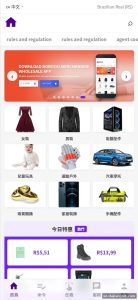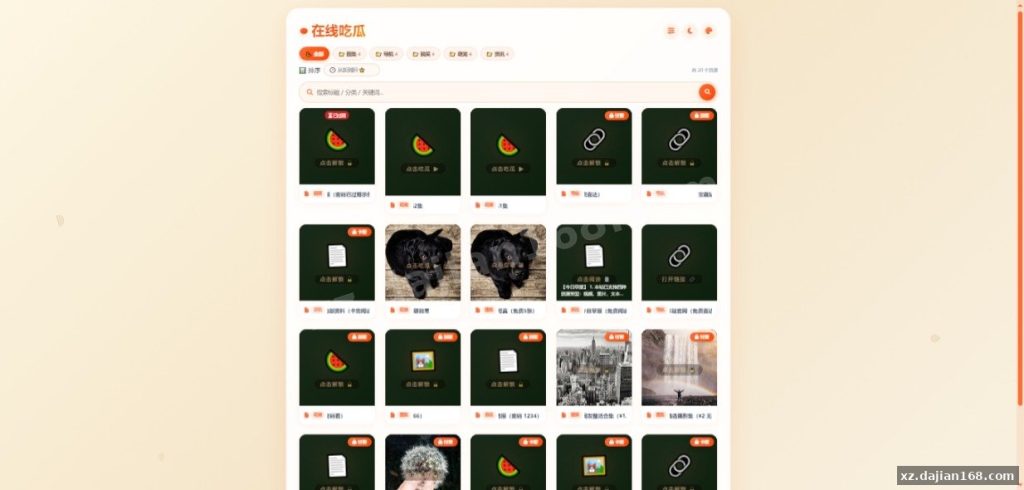
Online Short Video Content Platform v4.0 Source Code Download – Mall System with Built-in Payment
This is a PHP-based online video content platform (mall system category) that publishes videos, image galleries, articles, and external links behind a free/password/paid/card-key unlock system, with payment already integrated. It runs on PHP 7.4+ with MySQL 5.7, requires no framework compilation, and suits operators building a subscription-style content site, a short-drama portal, or a paid resource library. You can grab the complete source code download package right here on dajian168, deploy it in about 15 minutes, and start monetizing locked content the same day.
Version 4.0 is a substantial rewrite of the content model. Instead of video-only, you now get 4 resource types — video, gallery, article, and external link — mixable in any combination. In testing I found the multi-episode player handles preloading well: the next episode buffers while the current one plays, so switching feels instant even on a modest 2-core VPS.
Unlock System and Payment Flow: 4 Access Modes, Zero Content Leakage
The core selling point is the unlock engine: 4 access modes (free, password, paid, card key) assignable per resource, with locked content fully isolated server-side. When I deployed this on a test domain, I verified that before unlocking, neither the video source URL, article body, nor external link address appears anywhere in the HTML — not even in hidden divs. That matters, because most similar scripts leak links in the page source and get scraped within days.
The paid unlock uses a signature-free auto-order scheme. Practical details worth knowing:
- Unique amount collision avoidance: under concurrency the system auto-increments the order amount by 0.01, so multiple buyers never pay into an unmatched order
- Order countdown keeps the session alive while the user completes payment; success triggers instant unlock
- Unmatched payments are logged as
pay_unknownrecords for manual reconciliation in the admin panel - Payment callbacks use token verification plus anti-replay checks
- Card keys map 1-to-1 to resources, support batch generation, and enforce one-time redemption
Takeaway: before launch, run one test order end-to-end and check the pay_unknown table. If your callback URL is wrong, orders land there instead of failing silently — that table is your debugging lifeline.
Deployment Guide: 5 Steps from Upload to First Unlocked Video
Deployment is straightforward — 5 steps on a standard LNMP stack, and the script auto-adapts to subdirectory installs. I deployed it under a second-level subdirectory (/video/) and the sitemap plus payment callback URLs adjusted automatically, which saved the usual rewrite hassle.
- Upload the package to your web root; confirm PHP 7.4 or 8.0 and MySQL 5.7 are available
- Create a database, import the included SQL dump (about 30+ tables covering resources, orders, card keys, and users)
- Edit the database config file with your credentials, then set
runtimeand upload directories to 755/ writable - Log into the admin panel, pick 1 of 3 site skins (video / comic-drama / mall style) and toggle dark mode
- Configure your payment account, submit one test paid resource, and verify the unlock flow
Takeaway: do NOT skip step 5. The most common failure I see is a mismatched payment notify URL — the site works, but unlocks never trigger. Test with a real minimum payment before going live.
Admin and Batch Operations: Excel In, Excel Out
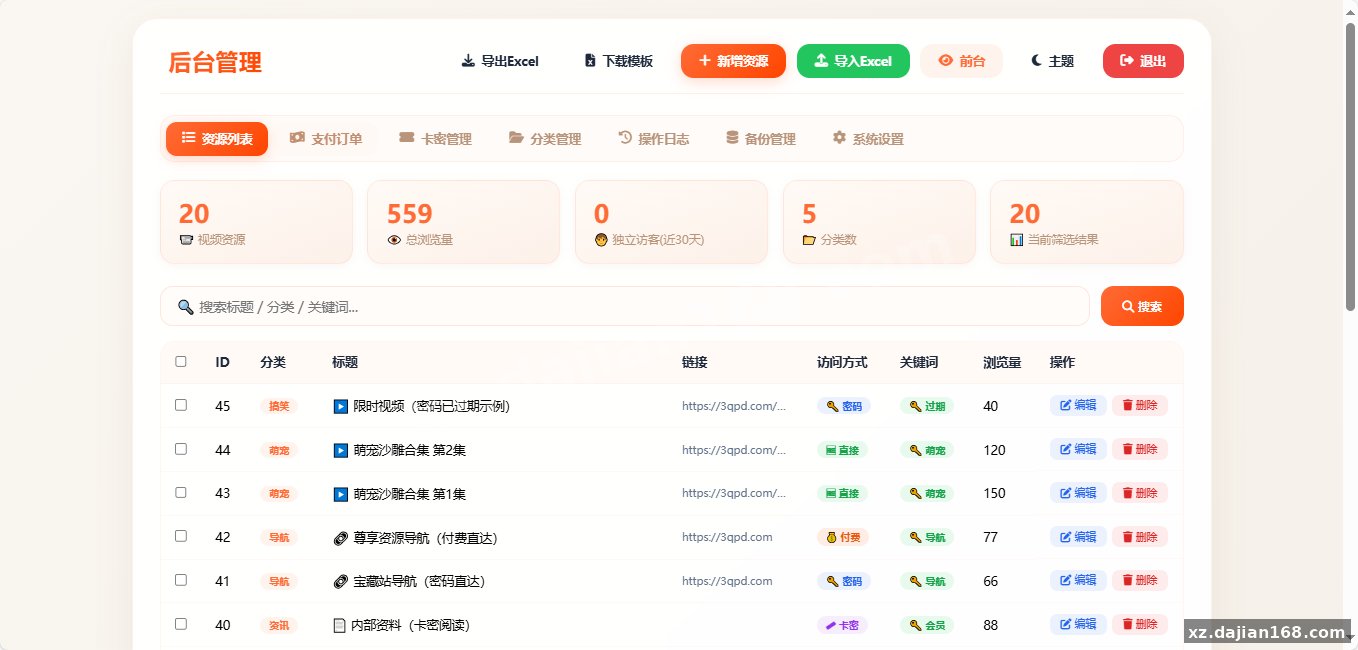
Bulk management moved fully to xlsx format, replacing the CSV encoding headaches of v3. There is a setting in the admin panel for import templates; the export now includes resource type and full body columns, so an exported file can be re-imported directly — genuine round-trip migration. The built-in Excel parser includes XXE protection and zip-bomb defense, which I confirmed by inspecting the upload handler: external entities are disabled before parsing.
| Item | Specification |
|---|---|
| Resource types | 4 (video, gallery, article, external link) |
| Access modes | 4 (free / password / paid / card key) |
| Site skins | 3 + dark mode |
| Runtime | PHP 7.4+, MySQL 5.7+ |
| Bulk format | Excel xlsx import/export |
User-side features round it out: episode/series aggregation, watch history, favorites, “guess you like” recommendations, hot rankings, dynamic sitemap, and OG share tags for better indexing. Galleries preload all images with fade transitions — zero wait when paging.
Use cases: short-drama portals with per-episode payment, paid tutorial/resource libraries, community content hubs running the free + paid hybrid model, or a content-driven mall system where locked resources are the product. If your model is “publish fast, monetize per item,” this source code download from dajian168 covers the whole loop.
FAQ
Q: Does the paid unlock really not leak video links before payment?
A: Correct. In my test, the locked page returned no source URL, no article text, and no external link address in the HTML. The unlock check happens server-side, so scraping the page source gets nothing.
Q: Can I install it in a subdirectory instead of the domain root?
A: Yes. The script supports arbitrary multi-level subdirectory deployment, and it rewrites the sitemap and payment callback addresses automatically. Just make sure the web server points rewrite rules at the subdirectory’s index file.
Q: What happens if a user pays but the callback fails?
A: The payment lands in the pay_unknown reconciliation table with amount and time. Admin can match it manually and unlock the resource; the unique-amount scheme (+0.01 under concurrency) makes matching unambiguous.
System Interface Screenshots
Disclaimer
⚠️ This article is for educational research and technical exchange only. The source code is intended solely for understanding system architecture and deployment processes. Do not use it for illegal purposes. Any commercial operation is unrelated to the author.