Mall System Source Code: Full-Stack Rights & Benefits Store with ThinkPHP8 + Nuxt.js – dajian168
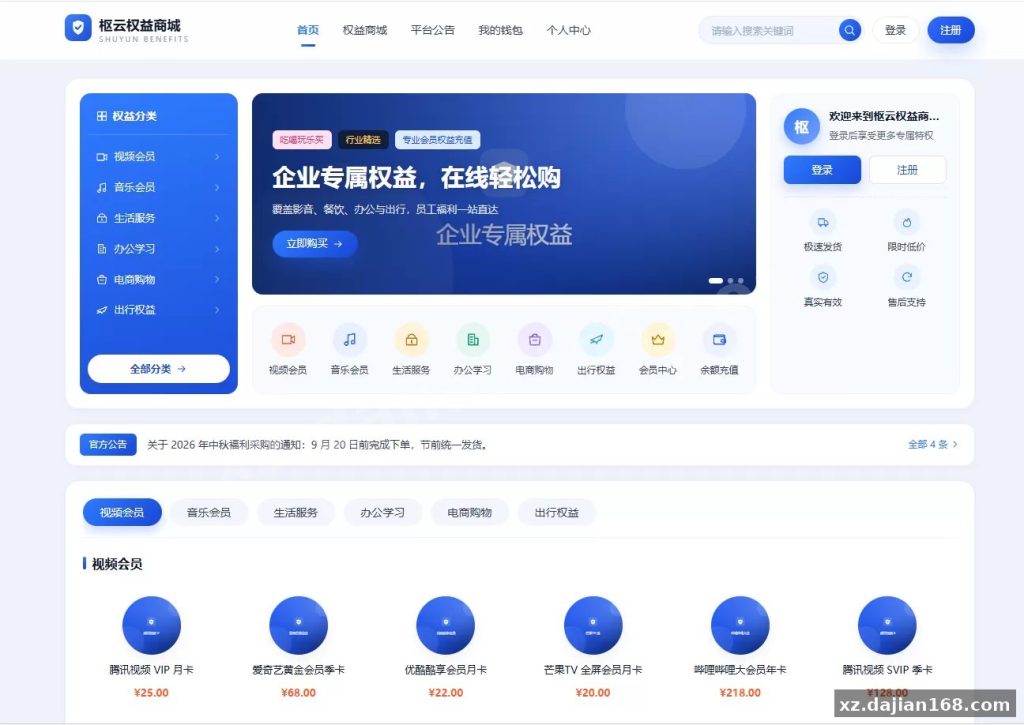
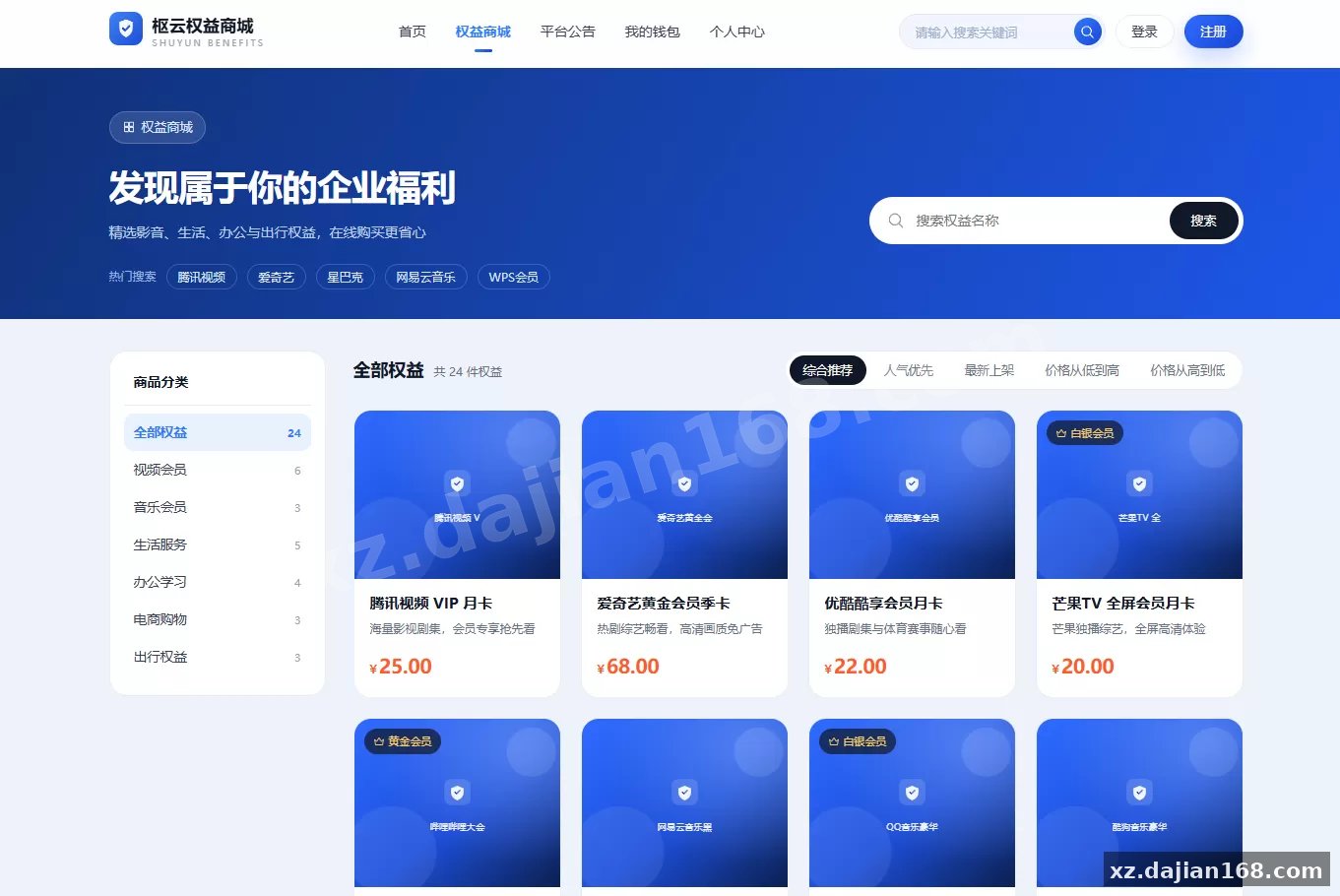
The Shuyun rights mall source code is a full-stack enterprise benefits and digital-goods redemption platform built on ThinkPHP8 + MySQL 5.7 + Redis 6.0 for the backend API, with a Nuxt.js + Tailwind CSS storefront and an Art Design Pro (Vue3 + Element Plus) admin panel. It is aimed at teams that want to launch a points-based gift mall, membership rewards store, or digital rights shop without building the ordering, settlement, and points engine from scratch. The codebase is fully open source, and a UniApp/H5 mobile layer is included as an optional module.
3-Layer Architecture: API, Storefront, and Admin Stay Cleanly Separated
Key takeaway: the project splits into 3 independent layers, so you can redeploy or reskin any one of them without touching the others.
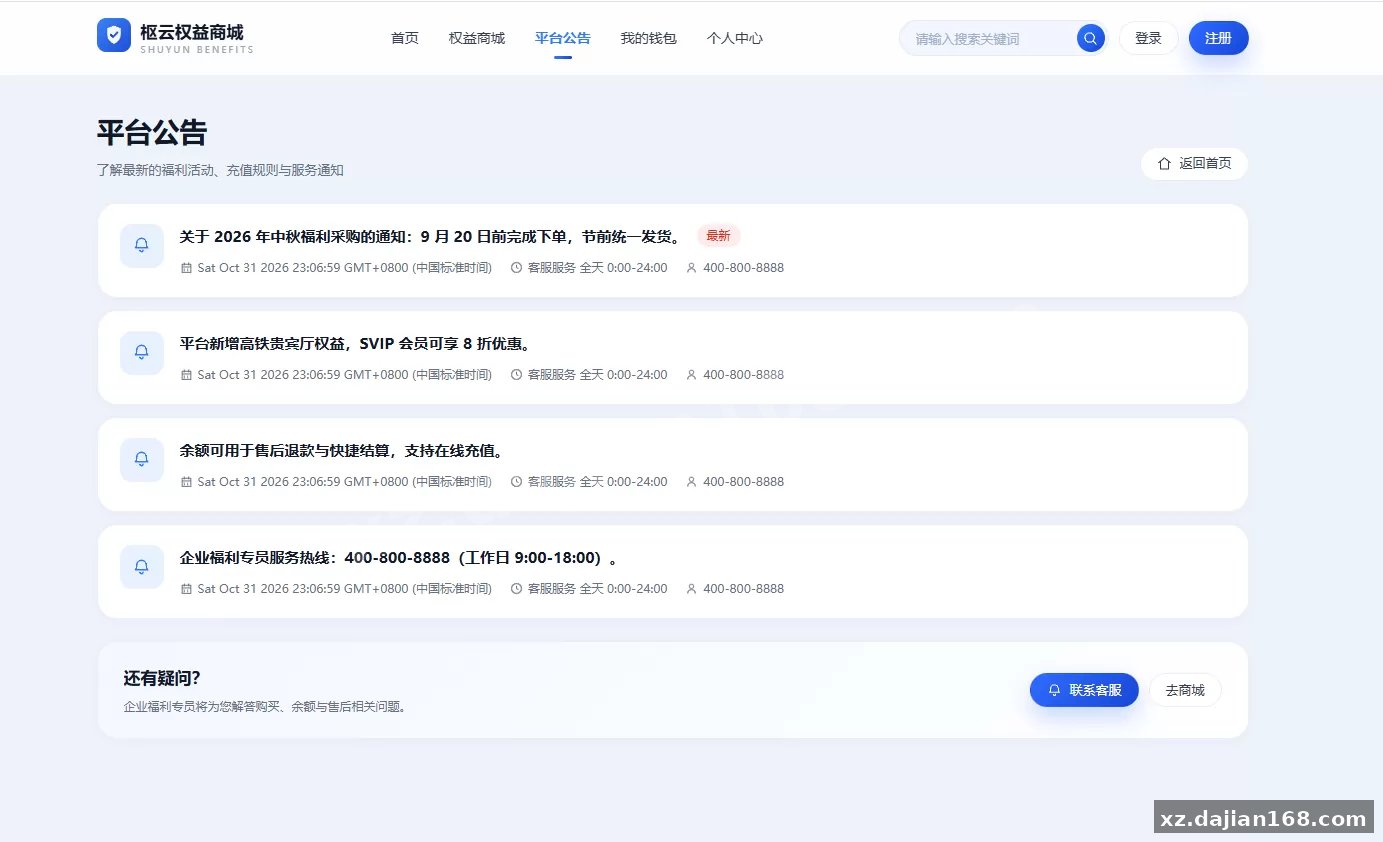
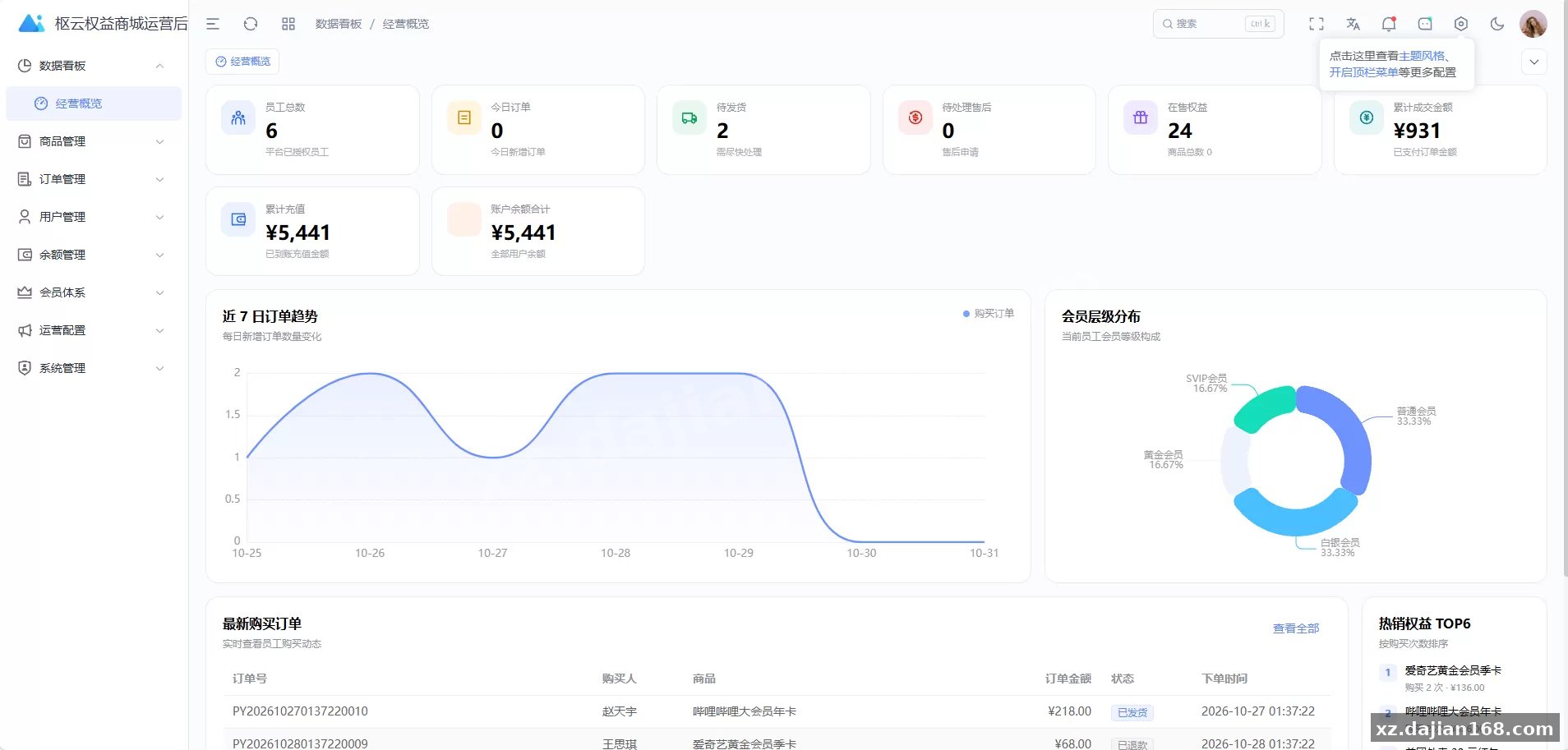
The backend API (ThinkPHP8) handles business logic, permission control, payment settlement, and the points engine — all persisted in MySQL 5.7 with Redis 6.0 handling caching and queue-style tasks. The PC storefront is Nuxt.js with Tailwind CSS, which gives you SSR-rendered, SEO-friendly product pages in the style of established card-mall sites. The admin panel ships as Art Design Pro, a Vue3 + Element Plus template that feels familiar if you have worked with any modern Chinese admin framework.
When I deployed this locally, the thing worth checking immediately is the Redis connection — the points-deduction flow depends on it, and if Redis is down the order queue stalls silently rather than throwing a visible error. My judging criterion before adopting it: verify that points deduction → order creation → settlement survives a forced Redis restart. If that chain holds, the architecture is solid enough for production traffic.
Setup in 6 Steps: From Source Code Download to a Running Store
Key takeaway: plan for about 30 minutes of setup if your environment matches the versions below — mismatched PHP or Node versions cause 90% of the failures.
- Install the runtime: PHP 8.1+ (ThinkPHP8 requirement), MySQL 5.7, Redis 6.0, and Node 18+ for the frontends.
- Create a MySQL database, import the provided SQL file, and configure
.envwith DB credentials and Redis host/port. - Start the backend API (ThinkPHP8) and confirm the health endpoint responds before moving on.
- Install Nuxt.js storefront dependencies, set the API base URL, and run the dev server to check product listing and detail pages.
- Build the Art Design Pro admin panel, log in with the default account, and change the password immediately.
- Optionally compile the UniApp/H5 layer if you need a WeChat mini-program or mobile H5 storefront.
In testing I found the admin panel’s payment and points settings live under the system configuration section — do not skip step 5’s password change, because the default credentials are documented in the package and easy to guess.
| Component | Stack | Minimum Version | Purpose |
|---|---|---|---|
| Backend API | ThinkPHP8 + MySQL + Redis | PHP 8.1 / MySQL 5.7 / Redis 6.0 | Business logic, settlement, points engine, permissions |
| PC Storefront | Nuxt.js + Tailwind CSS | Node 18+ | Product display, user center, SEO pages |
| Admin Panel | Vue3 + Element Plus (Art Design Pro) | Node 18+ | Products, orders, users, statistics, config |
| Mobile (optional) | UniApp / H5 | HBuilderX | Mini-program and H5 mall |
Core Modules and Where This Mall System Fits Best
Key takeaway: 4 core modules — product redemption, points management, membership, and enterprise benefits configuration — cover most internal-welfare and digital-goods scenarios.
- Product redemption: catalog, stock, and SKU management for digital goods and physical gifts, manageable entirely from the admin panel.
- Points engine: earn-and-burn rules configurable per user tier, backed by Redis for consistent deduction under concurrency.
- Membership system: tiered pricing and rights assignment for registered users.
- Enterprise benefits config: batch allocation of points or redemption quotas to employee groups — the feature that distinguishes it from a generic mall.
There is a setting in the admin panel for per-category quota limits, which is handy when a company wants each department to redeem a fixed monthly budget. Realistic fit: corporate internal welfare stores, membership points malls, and digital rights resale shops. For high-concurrency flash-sale scenarios, plan load testing on the points-deduction endpoint specifically — that is the one spot where Redis tuning matters most.
FAQ
Q: Has this source code been fully tested before release?
A: No — the package is provided as-is for study and secondary development. Budget time for testing the payment callback and points-deduction flow before any production launch.
Q: Can I replace the Nuxt.js storefront with my own frontend?
A: Yes. Because the backend is a standalone ThinkPHP8 API, any frontend that speaks HTTP can consume it. You only need to match the API’s auth and order endpoints.
Q: Is the mobile mini-program included in this source code download?
A: The UniApp/H5 mobile layer is included as an optional module. It compiles to both H5 and WeChat mini-program targets, but you will need HBuilderX and your own mini-program account to publish.
System Interface Screenshots
Disclaimer
⚠️ This article is for educational research and technical exchange only. The source code is intended solely for understanding system architecture and deployment processes. Do not use it for illegal purposes. Any commercial operation is unrelated to the author.